How-to
What size walking boots should you buy?
Published
Note: This page contains affiliate links. If you buy through them we may earn a commission at no extra cost to you. Learn more
In short
Buy the size that leaves about a thumb's width (roughly 15 to 20 mm) between your longest toe and the end of the boot with your heel pushed back, while the heel stays put when laced. For many walkers that is their normal shoe size; others need half a size up for toe room and thicker socks. Measure your feet in the evening with walking socks and check the maker's chart.
Products for this job
Compare all 7 productsLowa Renegade GTX Mid: leather upper, Gore-Tex
Check price on AmazonAffiliate linkMeindl Bhutan MFS GTX: leather lined, made in Germany
Check price on AmazonAffiliate linkScarpa Terra GTX: leather with Vibram Energy II sole
Check price on AmazonAffiliate link
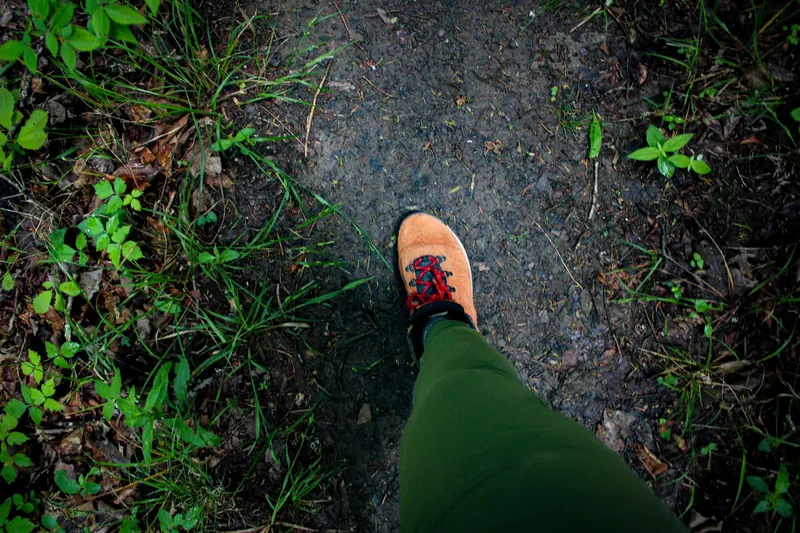
Should walking boots be a size bigger? It is one of the most common questions walkers ask, and the honest answer is: sometimes. What you need is the right amount of toe room without a loose heel. Too small and your toes hit the front on descents; too big and your foot slides, causing blisters. This how-to explains the thumb's-width rule, how to measure properly and how to test boots at home before you commit.
Why boots need toe room
Your feet swell during a long walk, especially in warm weather, and they move forward inside the boot on every downhill step. A boot that fits snugly at the toe in the shop can feel cramped after a few hours and bruise the toes on steep descents.
Walking socks are thicker than everyday socks, and many walkers wear them with aftermarket insoles. Both take up room inside the boot. That is why your walking boot size can be half a size larger than your everyday shoes, but not always.
Measure your feet properly
If you have measured in millimetres, add about 15 to 20 mm to get the inside length a boot should have. Makers rarely publish inside lengths, so use this as a check when trying boots rather than a buying rule.
- 1
Measure in the late afternoon or evening, when your feet are largest.
- 2
Put on the socks you will walk in.
- 3
Stand with your heel against a wall on a sheet of paper and mark the tip of your longest toe.
- 4
Measure the length in millimetres and do both feet.
- 5
Use the larger foot and the boot maker's size chart, or our boot size converter, to find a starting size.
The thumb's-width test
If you have almost no gap, go up half a size. If you can fit two fingers behind the heel, or your heel lifts a lot when you walk, the boot is probably too long or the wrong shape.
- 1
Unlace the boot fully and slide your foot in with your walking socks on.
- 2
Push your foot forward until your toes touch the front.
- 3
Slide a finger down behind your heel. About one finger's width of space is typical.
- 4
Now kick your heel back into the boot and lace up firmly.
- 5
Press the front of the boot: there should be roughly a thumb's width between your longest toe and the end.
Test at home before you walk outside
When ordering online, wear the boots indoors on a clean floor for an hour or so, so you can still return them. Walk up and down stairs: going down, your toes should not touch the end of the boot when laced well. Going up, your heel should lift only a little.
Check for pressure points over the top of the foot, on the little toe and around the ankle bones. A little stiffness is normal in new leather boots, but sharp pressure rarely goes away.
If you are between sizes, order both and keep the pair that passes the stairs test. If neither works, the last may not suit your foot; try a different brand or a wide fit. Our walking boots for wide feet guide lists roomier models.
When to size up, and when not to
Size up half a size if your toes touch the end on the stairs test, if you plan to wear thick winter socks or if you will add a thicker insole. Do not size up to cure a tight forefoot: it adds length, not width, and leaves your foot sliding. Look for a wider last instead.
Do not choose a boot that is too big expecting thicker socks to fill it. Extra sock bulk compresses and shifts, and the foot ends up moving. Lacing helps a little; see how to lace walking boots for heel-lock lacing.
Brand differences
Sizes differ between brands even when the number is the same. Italian brands often use EU sizes first; German brands usually list UK sizes in Britain. Women's models are cut differently from men's. Our walking boot size chart explains the conversions, and our guide to the best walking boots for UK hills compares established models you can try.
Frequently asked questions
Should you buy walking boots a size bigger? Not automatically. Aim for a thumb's width of toe room. For some people that means half a size up, for others their normal size.
How much toe room should hiking boots have? About a thumb's width, roughly 15 to 20 mm, with the heel pushed back.
Why do my toes hit the end going downhill? The boot may be short, or the heel may not be held well. See toes hitting the end of your boots downhill.
Do feet change size? Many adults find their feet lengthen or widen over the years, so re-measure before each new pair.
What you need
- Check price on AmazonAffiliate link
Lowa Renegade GTX Mid: leather upper, Gore-Tex
- Check price on AmazonAffiliate link
Hanwag Tatra II GTX (2E width): nubuck, leather lined
- Check price on AmazonAffiliate link
Scarpa Terra GTX Women: leather, Vibram Energy II