Guide
Which crampons fit which boots?
Published
Note: This page contains affiliate links. If you buy through them we may earn a commission at no extra cost to you. Learn more
In short
As a general guide, B1 boots take C1 strap-on crampons, B2 boots take C1 or C2 semi-automatic crampons that clip onto a heel welt, and B3 boots take C1, C2 or C3 automatic crampons that need toe and heel welts. Flexible B0 walking boots are not designed for crampons. Always check the boot and crampon makers' guidance and have the fit checked before use.
Products for this job
Compare all 7 productsZamberlan Vioz Lux GTX RR: leather lined, Gore-Tex
Check price on AmazonAffiliate linkScarpa Kinesis Pro GTX: 2.4 mm leather, Gore-Tex ePE
Check price on AmazonAffiliate linkMeindl Burma Pro MFS GTX: leather, Vibram Multigriff
Check price on AmazonAffiliate link
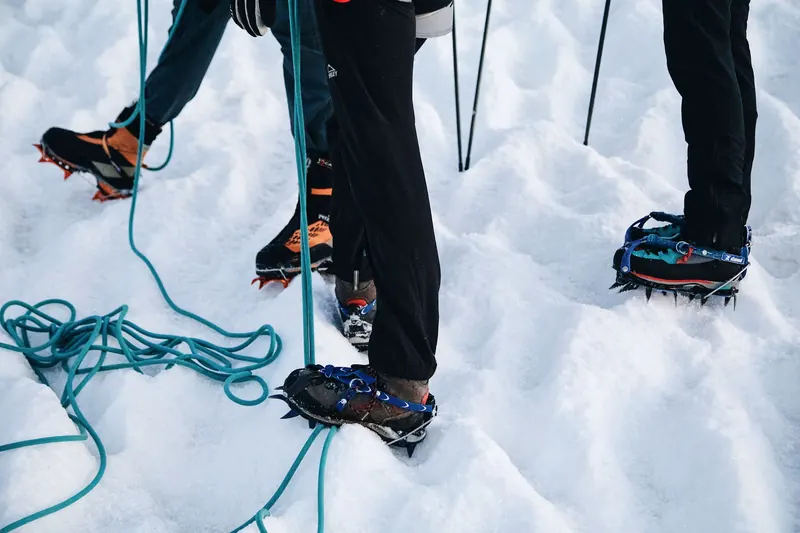
Crampons only work if they stay firmly attached to a boot that is stiff enough for them. A crampon on a bendy boot can flex, break or pop off at the worst moment. The UK B and C rating system is a shorthand for matching the two. This explainer covers the three binding types, the boot welts they rely on and how to check a fit, so you know what to ask about before your first winter walk with crampons.
The pairing rules
Boots and crampons are graded on matching scales. A boot rated B2 can take a C2 or C1 crampon, but not a C3. The table below summarises the usual pairings.
| Boot | Suitable crampons | Binding type |
|---|---|---|
| B0 | None | Not designed for crampons |
| B1 | C1 | Strap or flexible cradle front and back |
| B2 | C1 or C2 | Toe cage or strap with a heel clip |
| B3 | C1, C2 or C3 | Toe bail and heel clip (step-in) |
The three binding types
Strap bindings (C1) use nylon cradles or straps at the toe and heel, tightened with a strap over the foot. They fit almost any boot shape and do not need welts, which is why they suit B1 boots. C1 crampons are usually flexible or articulated so they move with a boot that still flexes slightly.
Semi-automatic bindings (C2) combine a toe strap or cage with a heel lever clip. The clip locks onto a heel welt, a ledge moulded into the back of the sole on B2 and B3 boots. This holds the crampon more securely than straps alone.
Automatic or step-in bindings (C3) use a wire bail at the toe and a heel clip. They need welts at both ends and a fully rigid boot, which is why they are paired with B3 mountaineering boots.
Why flexible boots and crampons do not mix
A normal walking boot bends at the ball of the foot with every step. A crampon attached to it is forced to bend too. Rigid crampons can crack under that repeated flexing, and even flexible ones can shift or detach. That is why B0 boots are not recommended for crampons.
On icy lowland or forest paths, some walkers use microspikes, which are chains with small spikes on a rubber harness. They are not crampons and are not suitable for steep snow or mountain terrain. Check the maker's guidance for any traction device you consider.
Note:Using crampons safely takes practice: how to walk, how to place your feet and when to take them off. Learn from a qualified mountain instructor or on a recognised winter skills course before relying on them in the hills.
How to check a fit
Crampons and boots both vary in shape, so a pairing that works on paper can still fit badly. A secure fit matters more than matching numbers.
- 1
Check the boot maker's information for the crampon types it accepts.
- 2
Take the boots and crampons to a shop with staff who can check the fit, or follow the crampon maker's fitting instructions closely.
- 3
Adjust the crampon length so the front points stick out just beyond the toe and the heel post sits snug.
- 4
Fit the bindings and shake the boot hard: the crampon should not move or rock.
- 5
Check that straps are not over the boot's flex point or pressing on the foot.
- 6
Recheck the fit with the socks you will wear in winter.
Choosing boots for winter
If you are buying boots with winter walking in mind, decide what kind of routes you will do with an instructor's or experienced club's advice, then choose a boot whose maker states compatibility with the crampons you need. Make sure it fits with thicker winter socks and that you can walk in it comfortably on the approach.
For three-season walking, choose a comfortable B0 boot; our best walking boots for UK hills guide is a good start, and leather walking boots covers sturdier models. Read walking boot ratings explained for the full B ladder and B1 vs B2 boots for the most common winter choice.
Frequently asked questions
Can I put crampons on hiking boots? Only on boots stiff enough for them, usually B1 or above with C1 crampons. Check the boot maker's guidance.
Do C1 crampons fit any boot? They fit most shapes thanks to strap bindings, but the boot still needs to be stiff enough. B0 boots are not recommended.
What is a heel welt? A ledge at the back of the sole that a semi-automatic or automatic crampon's heel clip locks onto.
Are microspikes the same as crampons? No. Microspikes are for icy paths and are not designed for steep snow or mountain terrain.
What you need
- Check price on AmazonAffiliate link
Zamberlan Vioz Lux GTX RR: leather lined, Gore-Tex
- Check price on AmazonAffiliate link
Lowa Renegade GTX Mid: leather upper, Gore-Tex
- Check price on AmazonAffiliate link
Lowa Tibet Evo GTX: calf-height leather trekking boot