Guide
How Gore-Tex walking boots work
Published
Note: This page contains affiliate links. If you buy through them we may earn a commission at no extra cost to you. Learn more
In short
A Gore-Tex boot has a thin membrane built into the boot as a sock-like bootie between the outer and the lining. The membrane has tiny pores that block liquid water but let water vapour from sweat pass out. It works best when the outer stays dry; once the outer fabric or leather is soaked, vapour escapes more slowly and feet can feel damp from sweat.
Products for this job
Compare all 7 productsMeindl Bhutan MFS GTX: leather lined Gore-Tex boot
Check price on AmazonAffiliate linkLowa Renegade Evo GTX Mid: leather, fabric lined
Check price on AmazonAffiliate linkLa Sportiva Nucleo High II GTX: leather, slip resistant
Check price on AmazonAffiliate link
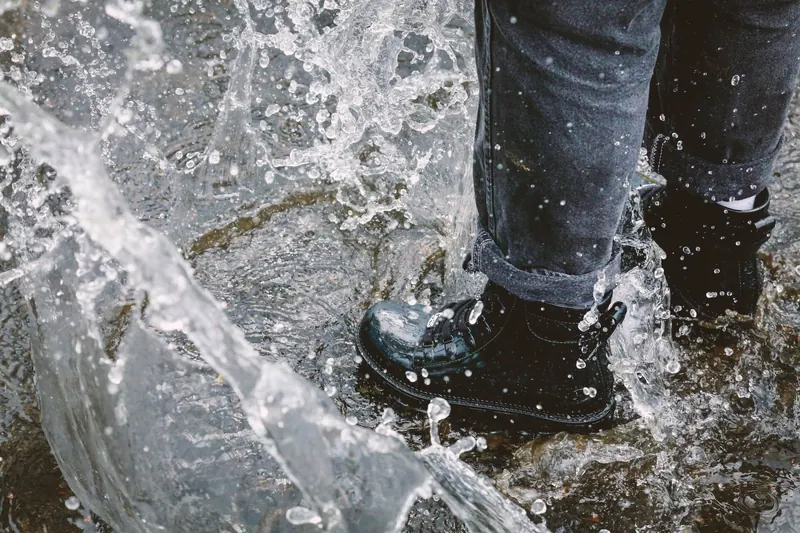
Gore-Tex, often shortened to GTX in boot names, is the best-known waterproof membrane in walking footwear, and most boots sold in Britain use it or a similar alternative. Understanding how it works helps you choose boots, look after them and know what to expect on a wet day. This explainer covers the membrane itself, the bootie construction, the limits of breathability, the newer ePE membrane and how other brands' membranes compare.
The membrane
The classic Gore-Tex membrane is made of expanded PTFE (ePTFE), a very thin film with billions of microscopic pores. According to Gore, the pores are far smaller than a water droplet but much larger than a water vapour molecule. That means liquid water from outside cannot get through, but vapour from sweat can pass out.
Gore has more recently introduced a membrane made of expanded polyethylene (ePE), described as free of PFCs of environmental concern. Some new boots, such as the Scarpa Terra GTX and Kinesis Pro GTX, list Gore-Tex Standard ePE and describe it as PFAS free. It works on the same principle.
The bootie construction
In a boot, the membrane is laminated to a lining fabric and made into a bootie, a sock shape that sits inside the outer. The seams of the bootie are sealed so water cannot seep through the stitching. The outer of leather, suede or fabric protects the membrane from abrasion; the lining protects it from your foot.
Because the bootie extends up to just below the top of the boot, a Gore-Tex boot is waterproof up to roughly that height. Water that comes over the cuff will get in.
Why wet outer fabric slows breathability
For vapour to escape, it must pass through the membrane and then out through the outer. If the outer is soaked, a state called wetting out, there is a layer of water outside the membrane. Vapour passes through much more slowly, and some condenses inside the boot. Feet then feel damp even though no water has leaked in.
That is why the outer has a durable water repellent (DWR) finish, and why reproofing matters. Keeping the outer shedding water keeps the membrane breathing. See how to reproof walking boots.
Breathability also has a limit. On a hot, strenuous day you may sweat faster than any membrane can move vapour. In those conditions, non-membrane footwear may feel more comfortable; see waterproof or non-waterproof walking boots.
Other membranes
Many brands use their own membranes or alternatives from other suppliers, often with names like eVent, OutDry or a brand's own waterproof liner. They work on similar principles, either microporous films or solid films that move vapour by diffusion. Performance varies by product and by the boot as a whole, not just the membrane.
When comparing boots, the presence of a membrane matters more than its brand name. Check the maker's description for what the boot uses and the warranty that comes with it.
| Factor | Effect |
|---|---|
| Membrane present | Keeps liquid water out up to the bootie height |
| Outer DWR and proofing | Keeps outer dry so vapour escapes |
| Upper material | Leather resists wetting out longer than fabric |
| Cuff height and gaiters | Stop water coming over the top |
| Socks | Wool and synthetic socks move sweat better than cotton |
Gore-Tex in shoes and trail runners
Walking shoes and trail running shoes with Gore-Tex keep out splashes and wet grass up to the collar, which is low. In deep wet grass or bog, water gets in over the top and then takes longer to dry than in a non-membrane shoe. Many trail runners choose non-membrane shoes in summer for that reason; others prefer a membrane in cooler months.
Our guides to walking shoes for hill paths and waterproof boots for men compare Gore-Tex models.
Getting the best from a Gore-Tex boot
If water gets in despite this, read walking boots leaking.
- Clean off mud after each walk so the outer can breathe.
- Reproof the outer when water stops beading.
- Wear wool or synthetic walking socks.
- Use gaiters and wear waterproof trousers over the cuff on wet days.
- Dry boots slowly, away from heat, to protect the membrane and glues.
Frequently asked questions
Are Gore-Tex boots fully waterproof? Up to the top of the bootie, yes, as long as the membrane is intact. Water over the cuff gets in.
Do Gore-Tex boots breathe? Yes, but less than an open mesh, and less still when the outer is wet.
What does GTX mean on boots? It is shorthand for Gore-Tex.
Is Gore-Tex worth it for UK walking? For most year-round British walking, a membrane helps keep feet dry on wet ground.
What you need
- Check price on AmazonAffiliate link
Meindl Bhutan MFS GTX: leather lined, made in Germany
- Check price on AmazonAffiliate link
Scarpa Terra GTX Women: leather, Vibram Energy II
- Check price on AmazonAffiliate link
Scarpa Cyrus 2 GTX: nubuck, Scarpa Presa sole